
Property Tax Reform Proposal
My proposal for property tax reform will reduce and stabilize property taxes. It will also incentivise local and state government to help protect middle and working class families from inflation.
Most Important Reform
The most needed reform in the Texas property tax system is to change the property appraisal method. I propose that property taxes be appraised using a combination of rental value of properties and household income levels. This will stabilize property tax amounts and maintain taxation levels that are consistent with the public’s ability to pay these taxes.
Reduce and Stabilize Property Taxes
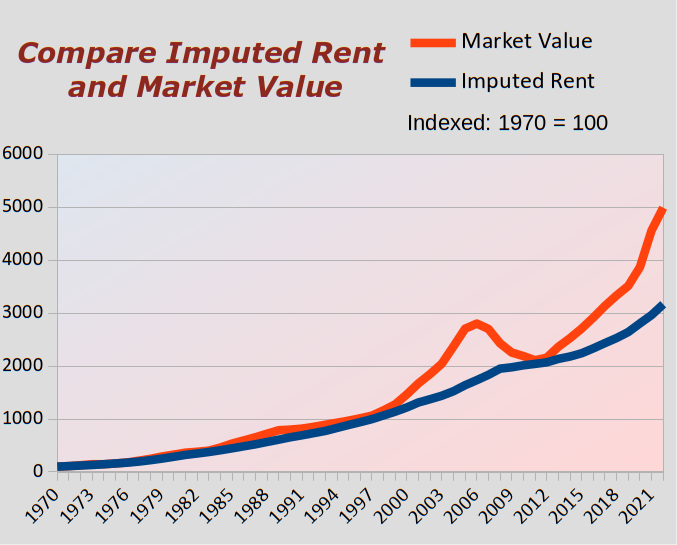
The current system uses real estate sales as the basis of appraisals. This method has a basic problem because it fails to account for the "boom and bust" cycle in real estate prices. As shown in the graph, the "imputed rental value" is much more stable than the "market value" of residential property. Imputed rental value is the Bureau of Economic Analysis estimate of rent values used in the Consumer Price Index (CPI) calculation. The current property tax appraisal system uses property sales —so called "comparable sales" —for tax assessments. Since the "market value" of real estate rises quickly in the boom phase of the cycle, property owners are caught with large increases in property tax that far exceed the rise, if any, in household income. As we see in the graph, the market value has continued to exceed rental value, resulting in property tax increases that exceed household income increases (Graph data from Federal Reserve Bank of St. Louis Series: A2013C1A027NBEA and BOGZ1FL155035013Q)
The real estate boom and bust is part of a credit cycle and, in my opinion, the Federal Reserve monetary inflation process. The monetary inflation process begins with increasing the mortgage loan amounts for real estate. With higher loan amounts, real estate prices begin to increase. Increased real estate prices induce more sales and also attract speculation and stimulate suburban development, which reinforce the price increase trend. Higher new mortgage amounts allow existing mortgages to be paid and replaced with the higher loan amounts. This also increases the money supply in the economy, increasing economic activity and creating the appearance of economic growth. This pattern will persist for several years and eventually be recognized as a real estate bubble. Over the course of a longer period, the monetary inflation from the real estate bubble will work its way through the economy, appearing as increased rents, increased consumer goods prices, and finally as increased wages and salaries. Note that real estate price inflation occurs many years before the wage and salary inflation.
The real estate bubble will drive real estate prices to unaffordable levels and will eventually end as speculation decreases. This is usually accompanied by a rise in interest rates by the Federal Reserve, which tends to reduce speculation and, with a significantly delayed effect, moderates consumer goods price inflation. Inflation of the money supply decreases and the economy enters a recession. Over a time period of more than a decade, wages and salaries will have inflated to the level where real estate becomes relatively more affordable, which sets the stage for the real estate inflation process —the boom and bust cycle— to begin again. However, the process usually results in a situation where real estate prices are higher in relation to incomes and not returning to the affordability level that existed before the real estate bubble.
To further refine the property tax system to account for Federal Reserve monetary inflation, we should implement an "increased mortgage interest tax," which would be payable by the owner of the mortgage debt and which would be enforced by requiring that the "increased mortgage interest tax" be paid as mortgage payments are received and prior to any foreclosure action or other transfer of the mortgage or the property. This tax would be based on the part of the mortgage that is higher than the appraised value of the property before the the mortgage debt was incurred.
Incentives for Government
The present property tax assessment system tends to raise taxes at the beginning of the inflation process since recent sales will be for a higher price, especially during a credit induced real estate bubble. This system also leads to higher tax revenues for government, which creates an incentive for state and local governments to promote real estate bubbles and maintain high property prices—favoring price rises and opposing price decreases. This also means that local governments are aligned with the banking cartel and property developers and against the local citizenry. This alignment is counter-productive because it results in an economy in which property ownership is unaffordable for the middle class and in which money is increasingly transferred out of the local economy to Wall Street banks and corporations.
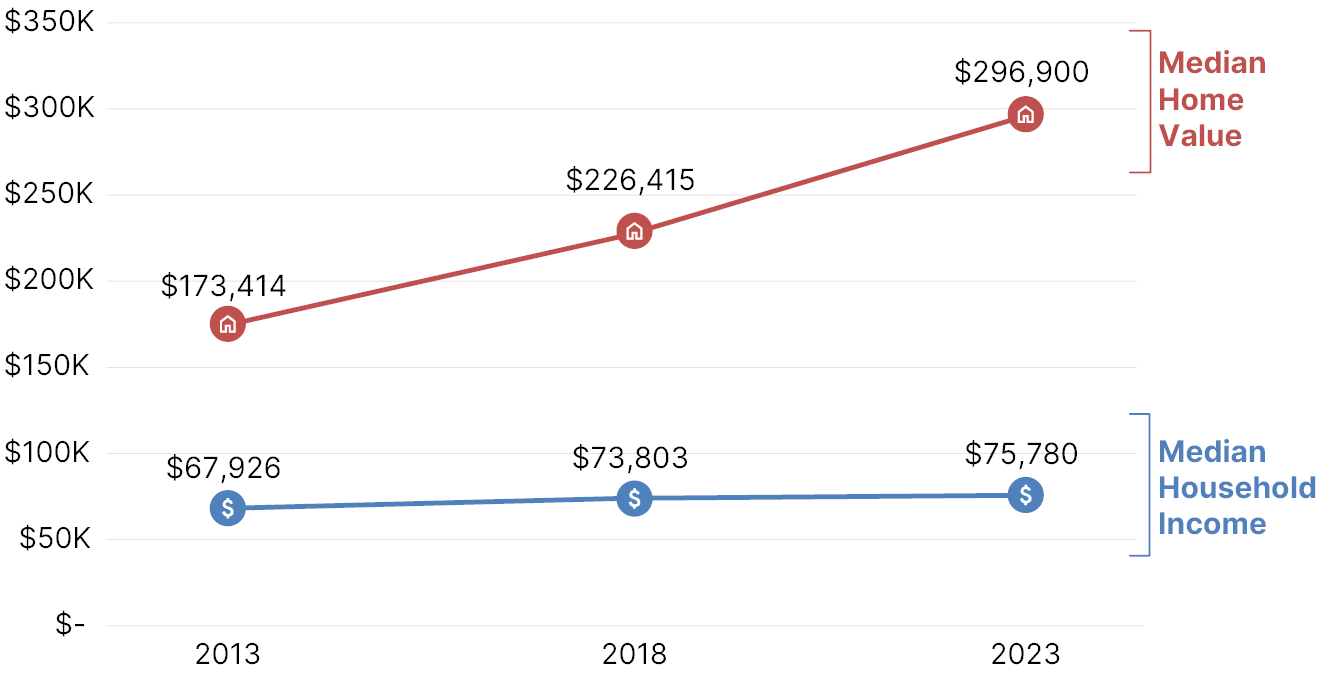
The rental value of property is directly related to the local income level. Under my proposal to base property tax assessments on local rental value and income levels, the incentive for local government will be to seek to increase household incomes. This will incentivize local and state government to focus on ways to promote better paying jobs and more successful small business. The incentive will be to promote household incomes because rental payments are dependent on local income levels and are not financed by the banking cartel. In addition, cities will become more focused on making urban spaces more appealing, livable, and more accommodating to residents while rural areas will seek to increase jobs and business opportunities.
Benefits to the Public
While no one likes paying taxes, we must realize that Texas is our state and we have to pay for it. For thousands of years property taxes were based on the economic value of land. The American reformer, Henry George, proposed that all taxation be based upon land rent value. It is quite possible for local and state government to provide valuable services to the public that are worth the tax bill. Local and state government spending that is wisely allocated circulates money in ways that are beneficial to the public and helps the economy. It is said that taxes are one of the inevitabilities. The issues are whether property taxes are fair and reasonable and whether the public is receiving good value for property tax payments. To accomplish the goal of government providing good value to the public, we must create the incentive system that will produce that result. By relating property tax assessments directly to the economic situation of the local population, local and state governments will have a direct incentive to help improve living standards and economic well being and to place the public welfare as the highest priority.
Would a State Income Tax Be More Fair?
You are not alone if you wonder whether a state income tax might be a way to fund necessary public functions and significantly reduce property taxes. The various arguments are summarized at What Are the Pros and Cons of a Texas Income Tax? However, a Texas state income tax is prohibited by the state constitution and would require a constitutional amendment to make it possible. Sec. 24-a. INDIVIDUAL INCOME TAX PROHIBITED. "The legislature may not impose a tax on the net incomes of individuals, including an individual's share of partnership and unincorporated association income." It appears the Republican Party candidates are campaigning against taxes, which is ironic since Governor Abbott (R) has presided over the largest tax increase in Texas history
Excessively high real estate values are an economic detriment. Property becomes so expensive that economic uses cannot be justified. It is not only high property taxes — the income that can be generated from the property is not enough to justify the mortgage, improvements, and taxes. Both rent and mortgage payments are unaffordable for many. One response is to increase tax on the land itself while reducing tax on structures and improvements on the land. Theoretically, this allows local governments to align market incentives with the public good. This problem has received considerable attention over the years and an informative discussion is found at Back to Earth: The Case for Lowering Speculative Land Values.
Another consideration is the very regressive nature of the Texas tax system. People with the lowest incomes pay the highest percentage of income in state taxes. The Texas tax system, sales tax and property tax, takes a much larger share of income from low- and middle-income households than of higher-income households. "Taxes on consumption and property … are nearly always regressive. The absence of an income tax makes it all but impossible for these states to counterbalance these regressive levies." ITEP: Who Pays? A Distributional Analysis of the Tax Systems in All 50 States
Texas' reliance on property tax should be compared with other states which have both a state income tax and a property tax system. Forty-one states tax wage and salary income. Variations in state income tax policy include flat or graduated tax rates, indexing for inflation, avoidance of marriage penalty, inclusion of capital gains, and standard deductions. States with the least regressive tax systems such as New York, California, and Massachusetts, have economic growth rates (GDP increase) that are comparable to Texas economic growth.
I think it is also important to consider that the purpose of a tax is to raise money for the government. Property is not money while income is money. Granted, money is very much involved in property ownership, but the need to translate property ownership into income often leads to circumstances that make high property taxes problematic for many people. I think a state income tax is something that should be debated in the upcoming legislative session.
Note: Fuel tax pays only about 10% of highway construction and maintenance costs. Most roadwork is actually done by cities and counties. Our auto-dependent transportation system is very expensive and makes other infrastructure more expensive as well. This is a big reason for high property taxes.
The more people who vote for me in the November 2026 election, the more likely it becomes that the Texas state government will raise the priority of serving the public by creating a more fair and equitable property tax system. Vote for Kevin McCormick for Texas Lieutenant Governor in November 2026.
Regards