
Health Care Proposal
Public health is more than the health care system and treatment of illness. Public health should be an important consideration in all legislation and state policies. Our state policies need to consider public health as a priority and our health care system needs a greater focus on preventive care. I am focused on what Texas can do to improve public health and health care for all Texans.
The treatment is more profitable than the cure
Health care is among the most pressing concerns for Texans. The United States, including Texas, has the most expensive and worst performing health care system of all western societies. No one needs reminding of the continuing health care cost spiral that has defied all efforts at containment. Given the Wall Street corporate control over our political system, economy, and health care, we should be mindful of the healthcare maxim for profit driven Wall Street: the treatment is more profitable than the cure. From a business perspective, curing patients will result in less profit compared to ongoing, chronic disease treatments.
There are three clear patterns that work together to increase health care costs while limiting improvement of health care outcomes. The first pattern is the consolidation of health care services into cartels and monopolies. Monopolization and preference for patented pharmaceuticals is also seen in the consolidation of health insurers, pharmacies, and providers. The second pattern is the increasing control exercised over Medicare and general health care access by insurance corporations, using corporate consolidation and the devices of prior authorization and provider networks. The third pattern is the continuing control of health care practices by the pharmaceutical and surgical health care model, excluding homeopathy and other alternative models.
Health care, which represents over 18% of GDP, is significant to Wall Street because it is one of the remaining corporate revenue sources not subject to foreign competition or loss of imperial prerogatives, in many ways a reflection of economic stagnation and de-industrialization, as shown in this quote from Health Care Costs and Affordability:
Currently, health care represents about 18% of the U.S. economy (measured as a share of gross domestic product, or GDP). In other words, almost 1 out of every 5 dollars spent in the U.S. goes toward health care. Back in 1960, health spending represented just 5% of GDP, meaning 1 in every 20 dollars in the U.S. economy was spent on health care.
The public interest is served by health care policies that promote health, reduce costs, and improve outcomes, which is the opposite of Wall Street corporate interests. Because the incentive for corporations is to increase revenues and profits, there is no reason to expect health care costs to decline or outcomes to improve on the basis of corporate actions or due to actions by either of the establishment duopoly political parties. Texas does have ways to reduce costs and improve outcomes, but at this point is simply following the corporate model and passively watching as costs continue to rise and outcomes continue to not improve.
Health insurance companies want you to believe that healthcare is expensive because of complex clinical care or rising labor costs. That is simply not true. Frontline patient care labor—physicians, nurses, and clinical staff—only makes up about 18% to 20% of total healthcare spending in America.
Health Care Costs and Category Share
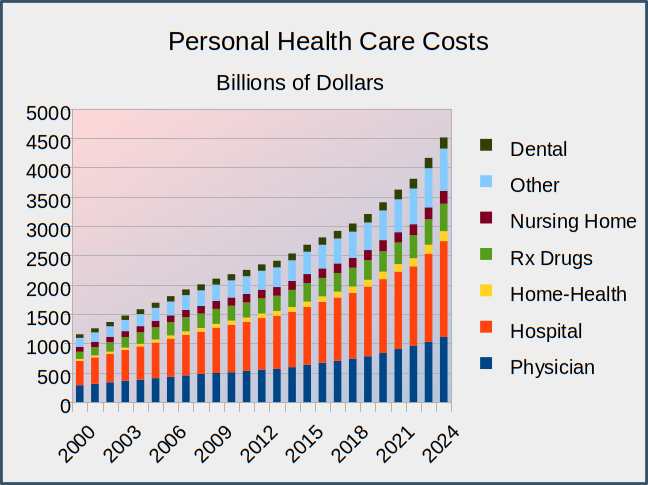
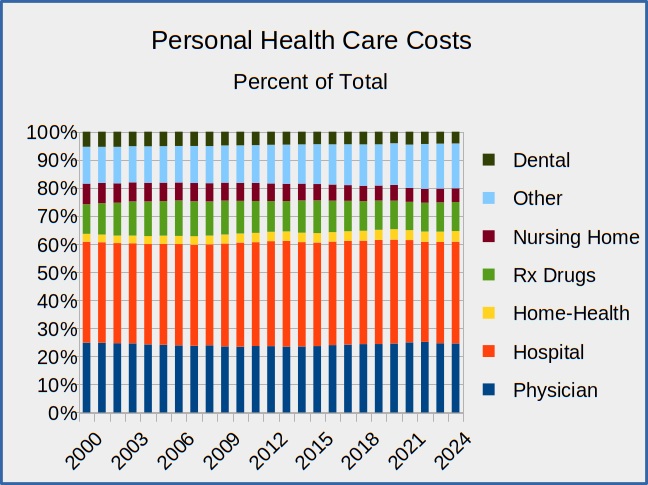
Wall Street continues to win the battle over health care costs. Total spending continues its exponential rise with only minor changes in the shares of category costs. Categories "Other" and "Home Health" have a slight increase in their share of costs, but overall there is very little change. (Data from NCHS Data Query System)
The public has proven its dissatisfaction with the establishment health care model through its increasing embrace of herbal supplements and other alternative approaches to health care. I personally find it rather ironic that there is a distinct lack of scientific research and medical knowledge about herbal remedies which have been used for thousands of years. This is evidence of the corporate and financial considerations that dominate our healthcare model.
There has been progress in the area of naturopathic medicine. The Association of Accredited Naturopathic Medical Colleges (AANMC) supports schools that are accredited by The Council on Naturopathic Medicine (CNME). There is some funded research in holistic medicine under the National Center for Complementary and Integrated Health (NCCIH). Texas does not presently allow naturopathic doctors to have a medical license, but the effort to gain this recognition is ongoing.
Instead of the corporate approach of dividing treatment into cartels of health care revenue sources, we could develop a theory of health. This approach would develop a theory of health that takes a holistic view and better understands the resources and factors that support human health and the factors that are detrimental to health. Some ideas worth considering are discussed in Towards a unified theory of health—and why natural health matters more than ever, which notes that human health is shaped continuously by the environments, systems, relationships, policies, and cultural and commercial forces in which we live. A theory of health would include policies that promote and sustain human and environmental wellness.
The obvious: preventing chronic disease
Perhaps the most obvious health care policy choice is to support prevention of chronic disease. The Center For Disease Control (CDC) states that
Most chronic diseases are caused by a short list of risk factors: tobacco use, poor nutrition, physical inactivity, and excessive alcohol use. By avoiding these risks and getting good preventive care, you can improve your chance of staying well, feeling good, and living longer.
These physical causes are well documented, but the CDC missed another well documented cause of chronic disease: social and economic inequality. Low social economic status (SES) is strongly associated with constant stress and increased chronic disease. Neuroscientist Robert Sapolsky measured stress hormone levels and discovered that the seemingly rigid status hierarchy of African baboons could transform from domination and persecution by aggressive members into a more sympathetic and supportive social order. This transformation lead to a significant reduction in stress which was actually reflected in levels of the stress hormone cortisol.
We have learned a lot about how poverty affects biology. Scientists have been able to trace physiological connections from external inequality to three key inner areas: chronic inflammation, chromosomal aging and brain function. Recent research links low SES with heavy allostatic load because the body is in a constant and futile battle to return to a normal, nonstressed state. These findings highlight an important theme: whereas an adult's SES predicts allostatic wear and tear, childhood SES leaves a stronger lifelong mark. Low SES predisposes youngsters' bodies toward earlier "aging."
The necessity of economic security
Income inequality and sources of stress have continued to take their toll on Texans, particularly those whose incomes are below the median income level. Incomes have only slightly increased while household expenses have risen much more quickly as high housing, transportation, groceries, child care, and utility costs continue to squeeze household budgets. The inequality is amplified in terms of after-tax income, since Texas has a highly regressive tax system. Texas ranks 38th in child poverty, with 18.4% of children living in a household below the poverty line.
Texas makes it difficult to sustain a family for households below the median income level. Texas has a very weak family and maternal leave policy, while child care can cost over 12% of family income. Texas has a very low ranking in terms of affordable housing for low income households. Texas is also the second worst state for food insecurity. Texas does far less than it could to reduce the stress of raising children.
Economic security has been defined as the "assured capacity of an economic unit, typically a household, to maintain a specific, acceptable standard of living without disruption." Different measures such as federal and state poverty thresholds and local cost-of-living standards may be used to asses economic security. Recent trends show that for households below the median household income, economic precarity and insecurity has been increasing.
Texas policy promotes chronic disease
The policies of the State of Texas actually work against the common-sense recommendations of the CDC and the effects of low social economic status, resulting in increased chronic disease.
- Texas restricts physical activity through the transportation system and auto dependency. Texas has low walkability scores because transportation policy actively discourages walking or cycling and forces people to use motor vehicle transportation in nearly every case where a person needs to go somewhere.
- Texas restricts access to healthy foods by making the Supplemental Nutrition Assistance Program (SNAP) as miserly and difficult as possible. Governor Abbott has recently vetoed the summer school lunch program, increasing food insecurity for the economically disadvantaged. Texas apparently has no policy to assure access to healthy food.
- Texas restricts access to primary and preventive care that is available under Medicaid. Preventive care under Medicaid is a patchwork and Texas does not take the steps to use Medicaid as an avenue for adult preventive care.
- Texas promotes toxic chemicals in the food supply. Texas favors the excessive use of fertilizers, herbicides, and pesticides in agriculture by promoting use of these polluting chemicals in its Generally Accepted Agriculture Practices (GAAP) and prevents local regulation. When we consider agricultural loan and crop insurance requirements that require following GAAP, it is clear that chemicals such as atrizine, chlorpyrifos, neonicotinoids, and glyphosate, are virtually forced on agriculture.
- Texas has deteriorated water quality due to excess nitrates and numerous chemical contaminants. Many rivers, streams, and reservoirs in Texas are polluted by chemical contaminants and agricultural runoff. Not only is municipal wastewater treatment inadequate, but large corporations are allowed to pollute Texas rivers and areas of the gulf coast are full of plastic waste.
- The Texas Environmental Quality Commission enforces rules that protect polluters rather than the public. Harmful chemicals are dispersed throughout the environment, but typically only landowners within one mile of a polluting facility are allowed to file complaints.
As reported by the Massachusetts Medical Society in Recognizing the Health Effects of Pesticides:
Pesticides are important but insufficiently appreciated causes of disease, subclinical disability and premature death. Although 70-90% of the risk of developing a chronic disease is tied to environmental factors rather than genetic or dietary ones environmental causes of disease receive substantially less attention than the latter in the lay press and in medical training.
Multiple pesticides have been detected in US groundwater systems and in agricultural produce, as well as in the US population at large. It has also been found that babies born in the U.S. may have over 200 industrial chemicals in their umbilical cord blood.
The fact is, a child can bear a lifelong imprint of risks from the countless molecules of industrial pollutants that find their way through the placenta, down the umbilical cord, and into the baby's body. The consequences — health disorders, subtle or serious — can surface not only in childhood but also in adulthood. Studies now support origins in early life exposures for a startling array of adult diseases, including Alzheimers, mental disorders, heart disease, and diabetes.
What can we do?
So what could the State of Texas do to improve healthcare outcomes and reign in health care costs? There are a number of things that could and should be done to benefit the public. Five changes we understand and which would be relatively inexpensive are:
- Texas could commission serious scientific research into use of native plants and herbal supplements, thus giving some support to holistic health methods. Texas has world-class universities and research centers which are more than capable of conducting this research.
- Texas could go further with improving the quality of public school breakfast and lunch services and offering them throughout the year and could use SNAP program expansion, or supplement SNAP benefits to increase access to healthy food.
- Texas could use federal funding to expand Medicaid coverage for lower income people in the state. Texas could also expand the use of Federally Qualified Health Centers (FQHCs).
- Texas could do much more to protect the public by reducing harmful chemicals in our food and water. Texas could remove toxic chemicals from its Generally Accepted Agricultural Practices.
- Texas could change the Insurance Code to provide for adequate payment for preventive primary care. Texas could require the design and implementation of a preventive primary care health care services model through the state employees health care insurance program.
Texas has recently taken a positive step with regard to nutrition by attempting to require warning labels on foods containing ingredients banned in other countries, prohibiting the use of certain food additives in meals served under free or reduced-price lunch programs, and by restricting the use of Supplemental Nutrition Assistance Program (SNAP) benefits for the purchase of sugary drinks and candies. (The law requiring warning labels was challenged in court by a collection of Wall Street interests — the American Beverage Association, Consumer Brands Association, National Confectioners Association, and Food Industry Association (FMI), with support from the U.S. Chamber of Commerce, the Pacific Legal Foundation, and the Goldwater Institute.)
Texas should expand the warning label regulation to include cosmetics and personal care products which have been linked to high levels of harmful chemicals in the human body.
While the Legislature has taken small steps to improve some areas of nutrition, it is clear the Legislature has no concept of public wellness and has not taken meaningful steps to increase access to preventive care.
Texas could use the examples of other states to limit corporate influence over health care. For example, insurance companies often require "prior authorization" for certain tests or procedures which can complicate care delivery, raises the costs and frustrations of medical practice, and which can amount to prohibited "corporate practice of medicine." Many refusals to authorize care by insurance company Medicare Advantage Organizations are overturned on appeal. A further example is the failure to use anti-trust powers to prevent the consolidation of health care providers into hospital and clinic system monopolies.
The Texas Insurance Code approves health insurance control of access to health care by specifically protecting health maintenance organizations and preferred provider plans, and provider networks. Health insurance corporations are specifically allowed to create and design networks of health providers and restrict health care access within the scope of the plan. The Legislature has also specifically authorized health care collaboratives which are providers that organize to provide medical services under an insurance corporation plan. It is clear the Texas Legislature has given insurance corporations the power to design, manipulate, and control health care in this state.
Develop a Preventive Primary Care System
Primary and preventive care can be understood as similar to a public utility. A preventive care system would consist of local, community oriented clinics that offer a range of health related services and providers, including physicians, nurse practitioners, registered nurses, clinicians, mental health providers, social workers, and nutritionists. The funding model for preventive primary care would consist of a baseline budget and payment for services.
Primary care has long fit awkwardly as an insurable risk in the marketplace. Insurance is designed to protect against large, unpredictable expenses. Yet primary care is largely predictable, similar to food, housing, and other common necessities."
Having a usual source of primary care was associated with having nearly 54% lower total health care expenditures for adults with chronic disease, and nearly 40% lower health care expenditures for children with chronic disease, compared to those who did not have a usual source of primary care. Millbank Investing in Primary Care Report ACCESSv04_Final
The process of developing preventive primary care, in a nutshell, involves planning and developing specifications; design of staff, technologies, physical space, and processes supporting patient care; measurement and oversight for internal performance; and self-study to examine positive and negative variances in care and outcomes. We have done this before and we do not need to re-invent the concept.
There has been a longstanding effort to increase preventive primary care, but access to preventive primary care has gradually declined. The first neighborhood primary care centers were begun under President Lyndon Johnson as part of the War on Poverty. The most recent iteration is organized around corporate principles such as use of electronic health records, accountable-care, relative-value-units, and pay-for-performance metrics. This form of organization of primary care has come with rising moral distress and disturbingly high levels of burnout in clinicians, community and personal disconnections, and inordinate and surprising dissatisfaction all around. Implementing High-Quality Primary Care: Rebuilding the Foundation of Health Care p.72
I believe this distress and dissatisfaction is the result of a mismatch in objectives and incentives. As noted, primary and preventive care does not fit well with the corporate insurance model, but corporate administrative and technological management methods have been applied. The preventive primary practice has the objective of achieving and maintaining health, which does not lead to a diagnostic condition reflected in a billing code. As the saying goes: "a stitch in time saves nine," but the preventive stitch has little value in the corporate insurance model.
One health care model that deserves increased attention is the Federally Qualified Health Center or FQHC. There are an increasing number of such centers and so-called "Look-Alikes" that operate in the U.S. and in Texas. While the FQHC is today considered for low income populations, it has delivered impressive results and it could serve as a general community-based health care model.
Texas currently has about 79 FQHC's in operation, which compares with about 171 FQHC's in California. FQHCs are community organizations with defined target populations and service areas that have a board comprised of at least 51% of members coming from their consumers. Services are provided to Medicare, Medicaid, CHIP, Insured, and Uninsured individuals. Patients may be eligible for discounted services on a Sliding Fee Scale based on their family size and income. Additionally, FQHC's cannot deny services due to an inability to pay.
FQHC's, provide comprehensive health care services to underserved communities. Many of the Texans they serve are indigent, uninsured, and underserved. Increasingly more FQHC's offer additional services, such as dental, mental health, and/or substance use disorder treatment. Surprisingly, the annual cost per patient is about $1,500 according to the Texas Association of Community Health Centers.
There are numerous examples of preventive primary care systems that operate in the United States.
Southcentral Foundation is an Alaska Native-owned 501(c)(3) nonprofit health care corporation delivering comprehensive outpatient and inpatient regional health services to more than 70,000 Alaska Native and Native American people living in the Indian Health Service's Anchorage Service Unit. Southcentral Foundation also provides a wide array of statewide outpatient and inpatient health services to more than 155,000 Alaska Native and Native American people living throughout Alaska.
The Nuka integrated primary care team supports structural, normative, and process integration; its core includes a primary care clinician, certified medical assistant, registered nurse case manager, and case management support. An integrated team with clinical behavioral health consultants, pharmacists, registered dietitians, midwives, and advanced practice clinicians supports the core team, with additional expertise, such as integrative medicine, brought in when needed.
Intermountain Health is the largest non-profit health system in the intermountain west and operates in Utah, Idaho, Nevada, Montana, and Wyoming, They describe themselves as ". . . reimagining healthcare . . . It's time to think of health in a whole new way. By partnering with our patients and communities, providing expert care closer to home, and making great health more affordable, we can help more people get and stay well."
Vermont Blueprint for Health: For 20 years, the Blueprint for Health has helped Vermont build a nationally recognized, community-based primary care system focused on better outcomes, healthier communities, and sustainable healthcare spending. The program created shared infrastructure — including care coordination, community health teams, data support, and quality improvement — that individual practices, especially rural and independent ones, could not build alone.
There are other examples of successful efforts to control health care costs and improve outcomes. For example, faith-based expense sharing organizations such as Medi-Share and Christian Healthcare Ministries have successfully reduced health care costs.
An important feature of these organizations is the lifestyle commitment. Beyond the faith requirements, applicants must meet health and lifestyle criteria: having abstained from tobacco and illegal drugs for at least 12 months before applying and having not abused alcohol, prescription medications, or over-the-counter drugs during that same period. There may also be a discount for members who meet certain physical health benchmarks, including targets for weight, abdominal circumference, and blood pressure. Both the head of household and spouse must independently qualify within 30 days of each other. These programs typically have a cost for clinic visits or hospital stays, similar to an insurance co-pay charge.
While I do not think it is possible or even advisable for the state to apply the health benchmark criteria discussed above, they do indicate the negative influence of state policies that restrict physical activity, promote illegal drug use through prohibition, restrict access to healthy food and water, and make it difficult to achieve economic security.
In addition to a proactive and preventive approach to state employee health insurance, Texas could copy the CalRx®, prescription drugs initiative which California claims "will break down market barriers to affordable prescription drugs for all Californians who need it." In particular, and perhaps its only item, CalRx® offers low priced insulin pens for diabetes treatment.
Is it possible for corporate insurance to deliver?
Texas could create a state employee insurance program design that includes the criteria for preventive care that has been demonstrated to reduce costs and improve outcomes. The state employee group health insurance plan is authorized under Texas Insurance Code, Chapter 1551.
Texas provides health insurance to state employees, using giant vertically integrated insurance corporations, which is based on the corporate health care model. Texas has fallen prey to the practices of vertically integrated insurers and monopolized healthcare services as demonstrated in the 2025 report by the Employee Retirement System or Texas.
After the FY24 savings experienced due to the new PBM contract, the pharmacy trend increased significantly in FY25. Glucagon-like peptide-1 agonists (GLP-1s), medication primarily covered for the treatment of Type 2 diabetes, continue to be a significant cost driver. FY25 medical trend was higher than historical norms, largely due to increases in utilization and rising hospital costs.
The ERS health insurance uses the corporate "in-network" model which allows the insurance company to design the network, restricts health care to providers in the network, and allows for "out-of-network" charges to be much higher. Alleged savings are based on arbitrary high prices that are discounted to be closer to market prices and thus produce a cost savings.
The ERS does implement a number of preventive and self-management components in its health insurance program. Despite this, the ERS projects an 8% increase in costs, with most of the additional funding coming from Texas taxpayers. The entire array of ERS services is administered by Wall Street corporations or affiliates. It would be appropriate to critically study the preventive and self-management components of the ERS plan to determine whether they are properly implemented and whether they are actually effective in improving health and reducing costs.
Given that the cost of primary care providers — doctors, nurse practitioners, social services, etc. is only about 20% of the healthcare cost profile, it seems that the ERS might benefit significantly from a preventive primary care model in place of the standard Wall Street insurance model.
Some conclusions
I hope I have made the case that Texas must address the health care system in a holistic way and develop a concept of public health. The state should take measures to improve economic security, improve access to healthy food, remove dangerous chemicals from our food and water, and make a healthy lifestyle more practical through the transportation system.
Texas should seriously re-examine the Insurance Code to reduce corporate power in health care and, importantly, create a strong foundation for improved preventive primary care. This includes a payment structure that pays for caring for people instead of only specific services, making preventive primary care available to all Texans, and assuring that the circumstances of each person are adequately taken into account in the process of care. The goals set out in the report Implementing High-Quality Primary Care: Rebuilding the Foundation of Health Care p.4 should become the public policy of Texas:
- An implementation framework, with three levels of change that accounts for the complexity of the U.S. health care system and its public- and private-sector actors.
- An accountability framework that establishes a structure and process for assessing the adequacy and completeness of implementation activities.
- A public policy framework that prioritizes developing government policy to implement high-quality primary care, consistent with its status as a common good.
Primary care is the only health care component where an increased supply is associated with better population health and more equitable outcomes. For this reason, primary care is a common good, making the strength and quality of the country’s primary care services a public concern.
Use your vote to make a difference. Your vote for Kevin McCormick for Lieutenant Governor in the November election will make it more likely that the Texas Legislature will seriously address the many health care issues facing us all.
Regards