
Election Code Reform Proposal
(updated 7/14/26) We all know that voting is important and that we should vote. In Texas you must register to vote and have an approved identification. Many people have become so discouraged by obstacles to voting or the lack of positive results connected to voting that they do not participate. Given the choice between the establishment parties, Democrat and Republican, it is understandable that many people feel their vote makes no difference. Please ask yourself, if voting does not matter, why does the establishment put so much effort into controlling elections? Your vote does matter and you can use it to help advance the process of positive change.
The Texas Election Code is a labyrinth of arcane procedures and requirements, which is evidence of the importance to the establishment parties of limiting democracy. The public is distracted by the corporate media news coverage which takes the approach of "horse-race" coverage — ignore the context, ignore the policies, ignore non-establishment candidates — just talk about which establishment candidate appears to be ahead. Media coverage of election rules and policies is non-existent because it would be nuanced and detailed with little emotional appeal. Election rules and policies have not-so-obvious effects on the process of democracy, either limiting or expanding the public's ability to influence and direct government. For example, Texas law provides that whichever candidate receives the most votes is the winner of the election. This is the first-past-the-post system which definitely favors establishment parties and creates the logic of having only two major parties.
The need to simply get more votes than any other candidate tends to produce two monolithic parties which compete in elections. This logic is no longer valid due to the donor class and corporations having control over both major parties. Despite the different campaign rhetoric and partisan talking points featured in the corporate media, there is actually little difference between the two major parties because they are both financially dependent on the donor class and major corporations. The two major parties offer only a choice in brand identity and divisive social issues — not a choice in meaningful economic policies.
Given that neither establishment party will adopt policies to reduce economically inequality or meaningfully improve the prospects for working and middle class families, we should reform the electoral process to restore the public's power in our democracy. The major reforms of the election process I am proposing are ranked-choice voting, limiting gerrymandering, and a statewide primary system for four parties and independents. I also believe other important goals of Election Code reform are to create a more positive and productive voting experience; allowing a wider range of viewpoints into the electoral debate; and reducing the divisiveness and polarization of election campaigns.
Election Reform Proposal
To accomplish these goals, I propose these reforms:
- All persons not disqualified from voting who receive a state issued identification should also be registered to vote in the county of the person’s address given in the identification.
- In each polling district there should be at least one voting machine for each one hundred eligible voters residing within the polling district and a sufficient number of polling places to prevent long lines and to have convenient locations.
- The candidate filing fee for statewide offices should not exceed $500, and should not exceed $100 for other offices.
- There should be a statewide general primary election in which the four parties with the most votes for statewide offices in the two preceding presidential elections are specifically included and a fifth category of "Independent" is also included. Participating voters would choose the category of primary election in which they wish to vote. Candidates in the Independent primary could state a party affiliation prior to the primary which would be included in determining the four parties having a category in subsequent primary elections.
- All primary, general, and special elections should be conducted by ranked choice voting in which the voter ranks the candidates for each office in order of preference. The candidate with the highest preference score would be elected or be the nominee in the case of a primary election.
- Electronic voting machines should be operated solely by published open-source software and should record voter selections electronically and generate two identical, clearly legible, paper print-outs of the voter’s selections. One print-out is for the election polling place supervisor and the other print-out is for the voter to keep and to permit one or more third party exit poll service to read and tally votes for the exit poll. Exit polls should be conducted in a clearly marked location convenient to the polling place exit.
- Electoral district boundaries should generally be rectangular in shape and the area should not be less than half the perimeter. The ratio of area and perimeter units, using the same number base, should not be less than 0.5 using the formula: 4π * area / perimeter^2. In the case where an irregular boundary line, such as a river or an existing municipal limit, makes a rectangular shape impractical, the ratio should be calculated by using a line connecting the two endpoints of the irregular boundary as part of the perimeter. The first district map drawn should be a square centered on the capital building in Austin, Texas. Electoral districts should only be redrawn every ten years in the year following publication of the United States census.
Texas should encourage voting
Texas consistently exhibits lower voter turnout rates compared to the national average across various election cycles. The reasons for low voter participation in Texas are reflected in the "cost of voting" index. Due to restrictive voting laws, Texas is third highest nationwide in terms of cost of voting.
Voting in some locations can take hours. It is important that voting be accessible and convenient. Having a two week early voting period and encouraging early voting can help reduce waiting times. Having an adequate number of voting machines is also essential. Experience shows that local governments do not spend enough on elections, but this is not an appropriate area for the government to economize. If we make voting more positive and productive we can make progress in protecting and revitalizing democracy in Texas.
Texas counties usually do not have a public space for local civic groups or parties to meet. This makes organizing a civic group difficult because finding a meeting place is difficult and often expensive. I believe that every county in Texas should have at least one public meeting place, maintained by the county, that is free to reserve a time for a civic group to meet. Public involvement does require that the public has the ability to participate in organizations and our government should have facilities to accomodate this need.
Candidates must file an application nearly a year before the election and pay an expensive filing fee. This prevents many potential candidates from filing because this deadline is so far in advance of the election and the fees are prohibitive for the majority of the population.
The Primary system is unfair
Under the Texas Election Code, only the Democrat and Republican parties hold statewide primary elections and the expenses are paid by the state. The Green and Libertarian parties are required to hold nominating conventions at the precinct, county, district, and state levels at a later date, with no expenses paid by the state. It is even more tedious for independent candidates. Independent candidates must file a Declaration, a Candidate Application, and a Nominating Petition with the required number of valid signatures. This process is complicated by Texas "party affiliation" rules which prevent persons who vote in a primary or convention from participating in a different party or signing nominating petitions.
Research shows that the current primary system leads to more extreme rhetoric from incumbents, which leads to pointless divisiveness in the electorate. Having a statewide primary election with four party’s candidates and independent candidates will increase voter participation and reduce the extremism that is incentivized by the current system.
My proposal for a statewide primary is not an "all party primary" proposal. Each party would have their nominees chosen by voters who vote specifically on that party’s nomination ballot. Having the party primary elections on the same day at the same place reduces most of the complications of the "party affiliation" rules.
Ranked Choice Voting
Ranked choice voting is another method to broaden participation, improve the electoral experience, and reduce divisiveness of partisan politics.
Ranked choice voting (RCV) produces election outcomes that better represent voter preferences. In RCV elections candidates compete for first and second-choice support, which lessens the incentive to run negative campaigns. Candidates do best when they reach out positively to as many voters as possible.
The ranked-choice voting process unfolds as follows for single-winner elections:
- Voters rank the candidates for a given office by preference on their ballots.
- If a candidate wins an outright majority of first-preference votes (i.e., 50 percent plus one), he or she will be declared the winner.
- If, on the other hand, no candidate wins an outright majority of first-preference votes, the candidate with the fewest first-preference votes is eliminated.
- All first-preference votes for the failed candidate are eliminated, and second-preference choices on these ballots are then counted as first-preference.
- A new tally is conducted to determine whether any candidate has won an outright majority of the ballots.
- The process is repeated until a candidate wins a majority of votes cast.
Electronic Voting Machines
Most voting in Texas uses electronic voting machines. Texas uses machines from Election Systems & Software (ESS) and Hart InterCivic, both of which sell proprietary, closed source systems. There is a history of Republican Party involvement with ESS. The Voluntary Voting System Guidelines (VVSG) are a set of principles and standards for the election equipment that Americans use to vote. The VVSG is managed by the Election Assistance Commission, which has two Republican party and two Democrat party members. Thus, electronic voting machines are firmly under the control of the duopoly political parties and secretive private companies.
Open source electronic voting machine software is freely available for inspection and evaluation. This provides the best assurance that the software is not vulnerable to hacking. Open source voting machines provide much better assurance of integrity than closed source systems with political connections. An example of an open source voting machine is found at Voting Works. There is also the example of STAR-Vote, a project that originated in Travis County, Texas, as well as the open source voting system in Los Angeles County, California.
Voting with electronic machines can be compromised at the voting machine, during the electronic transmission process, and at the storage and tabulation level. Complete freedom from partisan influence and transparency of the entire process is necessary to assure accurate election results and public confidence in the process.
Limit Gerrymandering
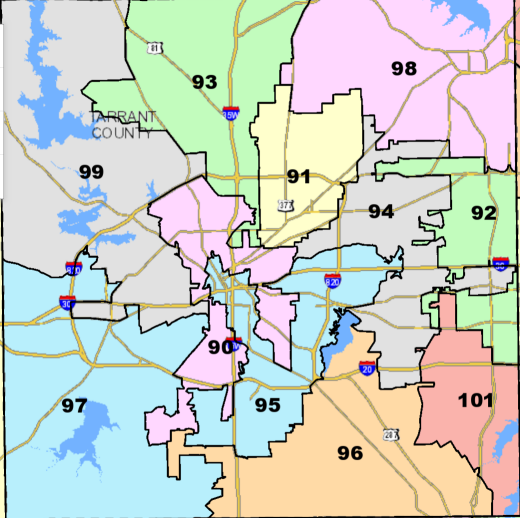
Gerrymandering is strategic drawing of district boundaries to increase the likelihood of future electoral success for one or more parties. In other words, the politicians select the voters rather than the voters selecting the politicians. The opportunities for gerrymandering are reduced by specifying requirements for the shape of electoral districts. I propose using the "Polsby–Popper test" which is the most frequently used mathematical test to measure the possibility of gerrymandered electoral districts and basically says that the district area must be at least half of the district perimeter. The best way to eliminate gerrymandering is to use a proportional representation system, as proposed in the Texas Green Party platform but I think that change would be too difficult to pass the Legislature. The goal is to put the voters back in charge of elections and not mathematical purity. It is probably also necessary to create a non-partisan electoral districting commission with its priority being to draw competitive districts following the shape requirements. Given the proclivity of elected representatives to use gerrymandering, it is necessary to have a constitutional amendment that creates a non-partisan electoral district commission and mandates the method of drawing electoral districts.
The Election System Needs to Change
In previous eras, political parties consisted of vast networks of people at local, state, and national levels, allowing parties to serve as central organizing entities within local communities. . . . Today’s political parties perform a much less integral mediating function. The hollowing out of political parties that has disconnected them from the role of local civic organization may be one of the problems contributing to the influence of primary elections in our system. How Primary Elections Impact Behavior in the U.S. House of Representatives
According to the paper People Around the World Want Political Change, but Many Doubt It Can Happen, 77% percent of Americans want major change in the political system, but only 27% are confident that the political system can change.
In terms of the U.S. Congress, the opinions of 90% of Americans have virtually no influence when they differ from corporate interests.
The central point that emerges from our research is that economic elites and organized groups representing business interests have substantial independent impacts on U.S. government policy, while mass-based interest groups and average citizens have little or no independent influence. Testing Theories of American Politics: Elites, Interest Groups, and Average Citizens, Martin Gilens and Benjamin I. Page
The electoral duopoly of the Republican and Democrat parties has become less and less representative of Americans. A recent Gallup poll finds that 45% of Americans identify as "Independent." Another Gallup poll finds that 58% of Americans believe we need a third major party. A recent poll in Texas finds that only 1 in 4 Texans approve of the Texas Legislature.
The election duopoly of the Republican and Democrat parties is further strengthened by the establishment media, which rarely, if ever, gives any coverage to third party candidates — the media coverage disparity. As far as the public knows from the media, there are only two political parties in Texas. Moreover, the corporate media has shifted to emotional and divisive reporting which appeals to a partisan audience. As Matt Taibbi states:
"In the post-objectivity era … media companies learned there is a consistent dependable way to make money. … You identify your audience … then you relentlessly feed that audience streams of stories that validate that audience’s belief system. And the easiest way to attract an audience is to present people that your audience does not like in a negative light." (minute 26)
The purpose of the Texas Election Code has been twisted from protecting the vote to protecting the monopoly position of the Democrat and Republican parties. Third parties, such as the Green Party or the Libertarian Party are required to follow outdated and impractical procedures and independent candidates are virtually shut out of the system. The Election Code serves to protect the establishment parties from competition … and from the voters. It effectively grants excessive influence to special interests, protects a political ruling class, and suppresses middle class, working family, and minority voters. The Election Code seriously needs to be reformed.
Use your vote to make a difference
The more votes that I receive in the 2026 election, the more likely it becomes that the Texas Legislature and state government will take action to improve the voting experience of Texans. Vote for Kevin McCormick for Lieutenant Governor.
Regards