
The Trump Administration has bludgeoned the cares and concerns of the Green Party membership. Yet, we must look behind the curtain to see what power enables the dictatorial aggression of the Trump Administration. This administration is characterized by dedication to fossil fuels, which reflects the enormous investment made by the banking cartel, which is central to the entire Wall Street structure. As reported by the Sierra Club, "Since the Paris Agreement, from 2016–2023, the world's 60 largest private banks financed fossil fuels with USD $6.9 trillion." In 2004 there was an additional $869 billion of bank finance for fossil fuels.
The financial elite have made steady progress toward the goal of fabulous wealth with little or no tax obligation. The " One Big Beautiful Bill" recently enacted will make tax cuts for the rich permanent, while tariffs on imports will supplement tax revenues. Since the Supreme Court has ruled many of these tariffs illegal, it remains to be seen whether the tariff concept can be a replacement for taxes the wealthy would have paid. The likely result will be higher prices and severe cuts to social programs that benefit lower and middle class Americans.
The Vision
Nevertheless, it appears the corporate royalty have chosen to follow the path of an AI generated South Sea Bubble. The projected visionary future is characterized by robotic workers, surveillance controlled public, huge fossil fuel consumption, imperial domination, and a winning response to China. It is a collection of corporate ideologue dreams wrapped up in one big beautiful narrative, fairy tale style. Like the historic South Sea Bubble, the context is competition to control government finance — stable coins versus treasury bills — widespread bribery — the fossil fuel industry spent $450 million to support Trump and Republicans in Congress — and imperial wars — Ukraine and Israel. The allure of a miraculous silver-bullet solution to the predicaments of a troubled empire seems not to have lost its appeal.
Back to Reality
The other side of the visionary future is the inflation and austerity that the ruling elite will seek to impose on the American public. We may anticipate this inflation and austerity in light of the 3-3-3 plan of Treasury Secretary Scott Bessent. This plan calls for 3% GDP growth, 3% of GDP federal budget deficit, and 3 million barrels per day increase in oil production.
This plan attempts to hide the structural weaknesses of the Federal Reserve Monetary System — an excess of debt, gross economic inequality, and an inability to address climate change. It does this by focusing on the financial issue of excess debt, increasing oppression of the working class, and denial of climate change. My humble opinion is that the financial issue will not be solved, oppression of the working class will continue, and climate change will slowly ruin whatever future there is for American society.
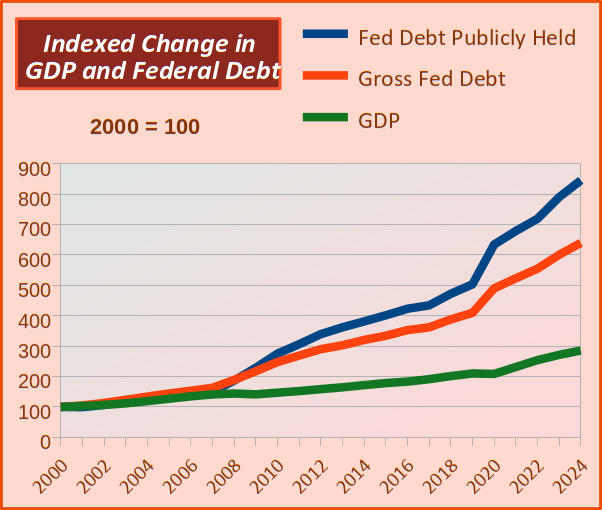
The notion of 3% GDP growth is colored by the protectionist and anti-worker features of the Trump Administration economic strategies. It will require a much more transformative economic policy than the present Trump policies of tariff protection and worker suppression, what I call the "company town America" policy. Yet, the 3% GDP growth will probably be the easy part due to continuing monetary inflation. One thing that makes GDP growth questionable is the present slump in the housing market.
The "rate of change" chart shows, since the year 2000, the publicly held federal debt growing at a 9.5%, the gross federal debt growing at 8.1%, and the GDP growing at 4.5%. This indicates that major, dramatic changes in these patterns are necessary for the 3-3-3 plan to work. Bringing the federal deficit to 3% of GDP will likely prove an impossible goal. (Graph data from https://fred.stlouisfed.org/, series FYGFDPUN, GFDEBTN, GDPA. See this article for an explanation of the federal debt graph.)
At this pace the federal debt will rise to $100 billion in 2036. The Government Accounting Office (GAO) has said:
"The federal government is on an unsustainable fiscal path that poses serious economic, security, and social challenges. . . . Publicly held debt is projected to grow more than twice as fast as the economy, reaching 200% of the size of the economy by 2047."
The 3 million bbl/day increase in oil production will encounter the headwind of flat to declining global demand. For example, China is consuming less gasoline and India is electrifying at a similar rate to China with fossil fuel imports flat to declining. In India, Fossil fuel power generation declined from 249 gigawatts to 240 gigawatts in 2025. Thus, U.S. fossil fuel consumption must rise to counter the lack of increase in global consumption. The Trump Administration hopes to accomplish this through blocking renewable energy and electric vehicles, as well as the energy demand of AI infrastructure.
Moreover, oil must be purchased with U.S. dollars in order for this aspect of the 3-3-3 plan to work, as the kidnapping of Venezuela President Maduro demonstrates. The implication is that we may expect the Trump administration to attempt to reverse the Saudi Arabia decision to sell oil in Chinese currency and to force Iran to sell oil in U.S. dollars only.
While the 3-3-3 plan seems implausible, the austerity program is clearly present. From a Food Bank crisis in the midst of growing hunger, to cutting wages for federal contract workers, to terminating union contracts of federal workers, the Trump administration is waging a comprehensive assault on the working class. Indeed, the One Big Beautiful Bill, also known as the 2025 budget reconciliation package, cut deeply into social safety-net programs while providing tax-cuts for the wealthy.
Beside safety-net and wage cuts, the Trump administration also denies that greenhouse gases endanger public health and is turning the Environmental Protection Agency into an agency that is willing to do everything in its power to prioritize corporate profits and capital. The EPA places no value on human life, but does place value on corporate profits.
The Remedy
The 3-3-3 plan is promoted as a plan to restore growth and balance to the U.S. economy, but behind the curtain is the maintenance of the Federal Reserve Monetary System. Were we to replace the Federal Reserve with the public money system described in the NEED Act, we would not be faced with an out-of-control federal debt, constant inflation, or incredible economic inequality. But the financial elite would lose their ability to create and issue money for profit, leading to loss of their control over the economy and the government. Thus, to protect this monetary system, we have the 3-3-3 plan showing our way to one big beautiful company town.